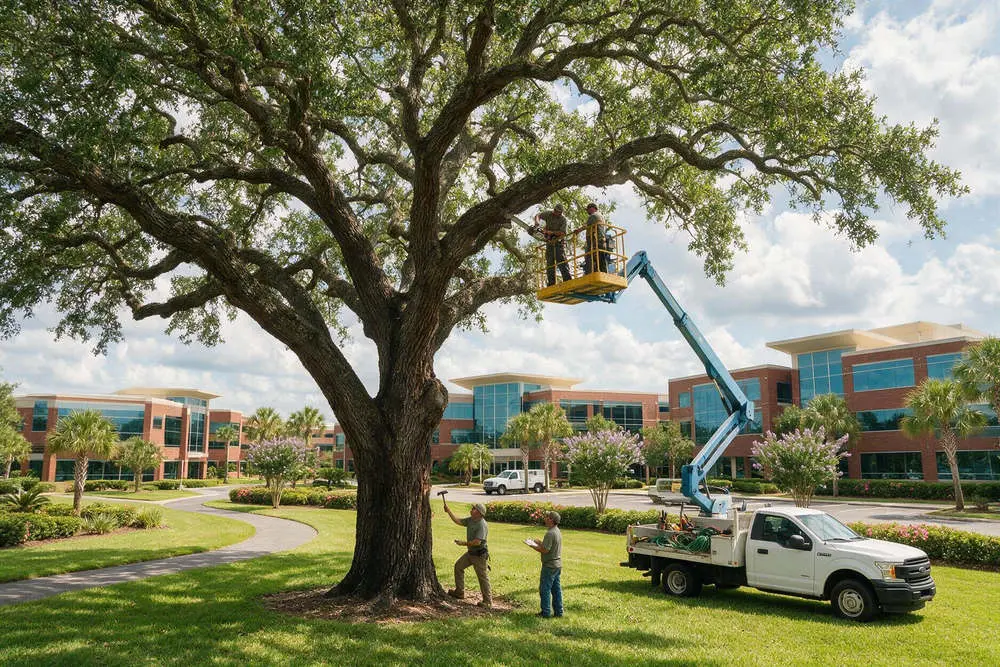
Preparing your commercial landscape for hurricane season in Central Florida is not a September task. By the time a storm enters the Gulf, your window for meaningful risk reduction is already closed. The decisions that protect your property, limit your liability, and keep your vendor queue short are made in May and June, not August. Plant This! works with facility managers and commercial property owners across the region to build that preparation into the calendar before the pressure starts. Contact Plant This! to schedule a commercial assessment or call (407) 676-4806.
Why pre-season timing matters for property liability
A weak limb over a parking lot in the Orlando metro is a slip-and-fall claim waiting to happen. When that limb comes down during a named storm and injures someone or damages a vehicle, the question your insurer will ask is whether you had documented evidence of routine tree inspection. Most property managers know this in theory. Far fewer act on it early enough to matter. A May arborist evaluation gives you a written record of tree condition before any storm event, which changes the legal posture entirely.
In Sanford and Lake Mary, where campuses tend to carry large live oaks and laurel oaks planted decades ago, that evaluation is not a formality. Mature canopy trees develop co-dominant stems, included bark, and decay pockets that are invisible from the ground but structurally significant. A credentialed arborist walking the property finds those issues. Commercial tree care at this stage means structural pruning to reduce sail area, remove deadwood, and eliminate the weak attachments most likely to fail at 80 miles per hour.
Drainage, grading, and the ground you can't see
Most post-storm flooding on commercial properties in Central Florida is not a roofing problem. It is a grading problem that has been accumulating quietly for years. Swales fill with sediment. Catch basins clog with organic debris. Mulch migrates and blocks flow channels. When six inches of rain arrives in four hours, as it did repeatedly during the 2024 and 2025 seasons, properties with compromised drainage turn parking lots into retention ponds. The Lakeside area in southeast Orlando is a straightforward example: low-grade sites near water features that drain fine in a thunderstorm and flood badly in a slow-moving tropical system.
Before the season, walk every swale and inlet on your property. Clear anything that blocks flow. Check grading against your original civil drawings if you have them. If you don't know whether your site drains correctly, a commercial landscape maintenance partner can flag those areas before they become a problem.
Landscape materials that become projectiles
This is the most consistently overlooked category in commercial hurricane prep. River rock, lava stone, and certain mulch types do not stay in place at tropical-storm wind speeds. In a multi-building campus or HOA setting, displaced stone becomes a window strike or a car claim. Lightweight decorative elements, potted plantings near entryways, and signage with poor wind load ratings all belong on a pre-season inspection list.
Practical steps before June 1:
- Audit all decorative stone and gravel areas. Deep mulch beds (four or more inches) hold significantly better than shallow ones.
- Remove or secure any container plantings at building entrances.
- Inspect exterior signage mounting hardware. Report anything loose to your facilities team.
- Confirm that any seasonal color beds are planted with species that can be cut back or removed quickly.
Secure a vendor relationship before everyone else does
After a major storm hits Central Florida, every qualified commercial landscaping company in the market is fully committed within 48 hours. Property managers who have no existing vendor relationship spend the first week after a storm making calls that go to voicemail. The ones who have a documented maintenance agreement in place get priority response, faster debris removal, and a faster path back to normal operations.
That relationship also has operational value before the storm. A maintenance partner who knows your property can identify which trees need emergency pruning, which areas drain slowly, and which materials need to be secured, without you having to explain the layout from scratch under deadline pressure. That institutional knowledge is worth more than any single service call.
Native trees and the ROI case for proper maintenance
Florida native trees, properly maintained, perform significantly better in high-wind events than fast-growing exotic species. Live oaks with well-spaced crowns and clear branch structure shed wind rather than catch it. The ROI on annual structural pruning is not just aesthetic. It is a direct reduction in the probability of a catastrophic failure that costs five to ten times as much to remediate.
Documented maintenance also supports your position if a claim is filed. An arborist report showing annual inspection and corrective pruning is material evidence that you exercised reasonable care. That documentation does not exist unless someone creates it, and the time to create it is before the storm season, not after.
If your commercial property in Central Florida does not have a hurricane-prep landscape plan in place for 2026, the window to act without scrambling is right now. Call Plant This! at (407) 676-4806 or schedule a commercial maintenance and tree-care assessment to get your property documented and ready before the season starts.